I recently went through a few parenting books. I gave some more time than others. Here are a few summarizing thoughts.
Grace Based Parenting
Like I've said previously, this is a big-idea book. It will help firm up a foundation for your parenting philosophy, from which you can then make parenting decisions. Key questions from this book: How is my parenting exemplifying God's relationship with his children? How am I preparing and strengthening my child (instead of simply protecting him)?
Secrets of the Baby Whisperer for Toddlers by Tracy Hogg (previously reviewed)
Detail-oriented book. Good while you're in the toddler phase (or, that is, your child is in the toddler phase). Hogg's philosophy is moderate (enforce limits, but no spanking), and she offers a lot of common sense solutions.
The Happiest Toddler on the Block by Harvey Karp, M.D.
I didn't give this book too much time, so if you love it you'll have to tell me why. The main idea of the book is to empathize with your toddler and speak with him in a way that he will understand. Sounds all well and good until the author gave the illustration of a mother and child using his technique. The mother ended up repeating what her toddler was doing (which included pounding and screaming) so that her toddler knew she understood, and then redirecting her toddler using toddler talk. The author also seemed to spend the majority of the book trying to prove that toddlers really were like prehistoric men in their speech, emotions, mental capacity, and behavior. To give you an idea of Karp's parenting philosophy, the discipline chapter is titled, "Gentle Diplomacy: Ways to Set Up and Enforce Limits." While I didn't get too much out of this book, I loved this illustration that Karp took from Your Two-Year-Old by Louise Bates Ames and Fraces Ilg. It describes Caleb's behavior perfectly.
The Mission of Motherhood by Sally Clarkson
I didn't get too far into this book. I tried. And tried again. But I couldn't get past the numerous references to the "fact" that men have a greater ability to focus and concentrate than women. If you know me, you know I love to submit to my husband, but I do that based on truth and wisdom, not on undocumented psychological "research." I'm sure there is good in this book; maybe I'll swallow my pride and try again sometime.
Still to read:
Shepherding a Child's Heart
Parenting with Love and Logic
What the Bible Says about Parenting
Any other recommendations?
If you haven't guessed by now, the primary way I learn is by reading. So I plan to read plenty of parenting books in the coming years. I have a lot of learning to do.
Showing posts with label reading. Show all posts
Showing posts with label reading. Show all posts
Monday, August 3, 2009

Friday, July 31, 2009
Vacation Reading
Water for Elephants by Sara Gruen
I actually finished this before vacation started. I started thinking that I'd just read a few pages and before I knew it, I had finished. I checked this book out of the library after hearing several people fawn over it. Even the librarian gave it high marks as I was checking out. Great story that includes too many crazy things to fit into one storyline, but it works. I loved the story, but I'm not sure all the explicit sexuality was worth it.
While hinting at poignancy at times, the story borders on "cute."
A Fine Balance by Rohinton Mistry
Recommended by my sister-in-law with a caveat for crudeness. I'd also recommend this one. (You can read the plot summary on Amazon if want some context for my review. It's easier and better than writing my own.) This was a rather ironic choice of books to read while I sat in luxury on Florida beach. I think I left the hotel house cleaner a bigger tip than I normally would have. It reminded me of reading Anna Karenina, hoping the characters would find hope and somehow knowing they wouldn't. Hopefully I don't surprise anyone with that, but you really shouldn't read this book expecting a happy ending. Mistry's writing is excellent--subtle yet thorough character development, plenty of foreshadowing, irony, interwoven stories, and of course, a depressing ending. (It can't be literature without a sad ending, right?) Thoroughly Indian in its setting, I couldn't help but wonder what a book about American depravity would look like.
Not a cute book at all, but seriously good writing.
Shadow of the Hegemon by Orson Scott Card
One of the many books meant to capitalize on the success of Ender's Game, a "save the world" science fiction novel. Unfortunately, Shadow of the Hegemon is not very successful, in my opinion. In Ender's Game it seemed like the kids were smart and insightful problem-solvers. This book just seemed to be full of kids who thought they were smarter than they really were, and those type of kids (people) just aren't very endearing. Add to that a sloppy treatment of cultural ideologies, and I didn't become a fan. This is the "cleanest" book of the three, but I didn't gain anything from reading it either.
Not bad airport reading.
(By the way, I would recommend Ender's Game and Ender's Shadow for their insight into human interactions--and for the pure enjoyment of reading them.)
I actually finished this before vacation started. I started thinking that I'd just read a few pages and before I knew it, I had finished. I checked this book out of the library after hearing several people fawn over it. Even the librarian gave it high marks as I was checking out. Great story that includes too many crazy things to fit into one storyline, but it works. I loved the story, but I'm not sure all the explicit sexuality was worth it.
While hinting at poignancy at times, the story borders on "cute."
A Fine Balance by Rohinton Mistry
Recommended by my sister-in-law with a caveat for crudeness. I'd also recommend this one. (You can read the plot summary on Amazon if want some context for my review. It's easier and better than writing my own.) This was a rather ironic choice of books to read while I sat in luxury on Florida beach. I think I left the hotel house cleaner a bigger tip than I normally would have. It reminded me of reading Anna Karenina, hoping the characters would find hope and somehow knowing they wouldn't. Hopefully I don't surprise anyone with that, but you really shouldn't read this book expecting a happy ending. Mistry's writing is excellent--subtle yet thorough character development, plenty of foreshadowing, irony, interwoven stories, and of course, a depressing ending. (It can't be literature without a sad ending, right?) Thoroughly Indian in its setting, I couldn't help but wonder what a book about American depravity would look like.
Not a cute book at all, but seriously good writing.
Shadow of the Hegemon by Orson Scott Card
One of the many books meant to capitalize on the success of Ender's Game, a "save the world" science fiction novel. Unfortunately, Shadow of the Hegemon is not very successful, in my opinion. In Ender's Game it seemed like the kids were smart and insightful problem-solvers. This book just seemed to be full of kids who thought they were smarter than they really were, and those type of kids (people) just aren't very endearing. Add to that a sloppy treatment of cultural ideologies, and I didn't become a fan. This is the "cleanest" book of the three, but I didn't gain anything from reading it either.
Not bad airport reading.
(By the way, I would recommend Ender's Game and Ender's Shadow for their insight into human interactions--and for the pure enjoyment of reading them.)
Wednesday, July 1, 2009
Secrets of the Baby Whisperer for Toddlers
I usually scoff at books that are rewritten for a niche market. It starts with a general title like Healthy Eating, for example. Then the author or publisher (I really don't know which) decides they want to make more money, so they publish the same content with a few different stories and title it Healthy Eating for Women. And the cycle continues until you end up with books titled Healthy Eating for Centenarians and Healthy Eating for Baseball Fanatics.
That being said Secrets of the Baby Whisperer for Toddlers has mostly new content, even though the author's philosophy is consistent with her first book. I haven't scoffed at toddler books (yet) because I feel like I recently entered a whole new arena of parenting. We've somewhat figured out how to help Caleb eat and sleep well. Now I need to figure out what to do when his will and my will don't match.
Hogg's book has some helpful tips and common sense parenting skills if you're interested in raising civilized children. While I hope my children will be civilized, that's not my whole goal as a parent, so this won't be my only resource for parenting strategies and skills.
A few highlights (Some are helpful; some are just to show Hogg's opinions):
That being said Secrets of the Baby Whisperer for Toddlers has mostly new content, even though the author's philosophy is consistent with her first book. I haven't scoffed at toddler books (yet) because I feel like I recently entered a whole new arena of parenting. We've somewhat figured out how to help Caleb eat and sleep well. Now I need to figure out what to do when his will and my will don't match.
Hogg's book has some helpful tips and common sense parenting skills if you're interested in raising civilized children. While I hope my children will be civilized, that's not my whole goal as a parent, so this won't be my only resource for parenting strategies and skills.
A few highlights (Some are helpful; some are just to show Hogg's opinions):
- Your expectations may change, depending on your child's personality.
- Praise only for a job well done. (advice also given in Grace Based Parenting.)
- The importance of rituals and routines. Hogg quotes Barbara Biziou: "By using rituals, we help ourselves and our children make better sense of the world. They begin to regard even the mundane as sacred moments of connection and togetherness" (pg. 68).
- Rituals/routines can be as simple as washing hands before eating.
- Prime time for potty training (in Hogg's opinion) is 18 months-2 years.
- Practice skills at home before expecting your child to perform/behave in public.
- Discipline (Hogg offers 12 points for "conscious" discipline. Some seem standard--know your boundaries, model, say no, praise good behavior, etc. Some helpful points for me: plan ahead, offer closed-end choices, pick your battles.)
- Offer closed-ended choices. For example, instead of asking, "Are you ready for your bath now?" which really doesn't give your toddler any choice, ask, "Would you like to use the red washcloth or the blue washcloth?"
- While one of Hogg's points said "Don't rely on corporal punishment" (spanking, flicking hands, hitting, etc.), she actually said never use it.
After reading baby books and now a few toddler books, I'd say Hogg's Baby Whisperer philosophy is rather moderate in approach. She's big on respecting children's feelings and wishes, but she's also big on teaching children to respect the world around them.
Tuesday, June 30, 2009
Grace Based Parenting, Recap
While a good book, this was not an earth-shattering book for me. A fact which is mostly due to my own parents and upbringing. Grace Based Parenting is a "big idea" book. It does not tell parents what to do when their toddler has a meltdown in the grocery store or their teenager gives them the silent treatment for weeks on end. It does help establish a foundation on which parents can make those type of decisions.
The main idea of the book is that parents should act towards their children in the same way God acts toward his children--with grace.
In order to silence some critics, Kimmel spends a chapter giving examples of families who have erred on the side of too little grace and families who have mistaken cheap grace for true grace. If you really want to understand true grace, I would not start with this book. Start with Romans, The Discipline of Grace by Jerry Bridges, this message by Erin Bird, or The Cost of Discipleship by Dietrich Bonhoeffer.
A few nuggets I appreciated:
A few things I didn't like about the book:
The main idea of the book is that parents should act towards their children in the same way God acts toward his children--with grace.
In order to silence some critics, Kimmel spends a chapter giving examples of families who have erred on the side of too little grace and families who have mistaken cheap grace for true grace. If you really want to understand true grace, I would not start with this book. Start with Romans, The Discipline of Grace by Jerry Bridges, this message by Erin Bird, or The Cost of Discipleship by Dietrich Bonhoeffer.
A few nuggets I appreciated:
- Definition of love: "Love is the commitment of my will to your needs and best interests, regardless of the cost."
- You should not be surprised or ashamed when kids sin; expect it. They have a sin nature.
- Don't just protect kids; protect and prepare them. Parents lead and encourage kids to live a great spiritual adventure, which is not safe. Teach them confidence in the fact that God is mighty and able to overcome all the sin and evil in you, me and the world.
- I also appreciated Kimmel's focus on the big ideas. As I always heard my dad say: "Major on the majors; minor on the minors." If you get the big things right, won't the small things either fall in line or not matter?
A few things I didn't like about the book:
- Kimmel provided many negative examples (what not to do) and not as many positive examples (what to do). It's easy to see mistakes that parents make. I'm reading a parenting book so that that I know what to do instead of continuing on in the dark.
- Kimmel suggested parents hold a "What's Your Beef" Family Night, in which they encouraged their children tell them anything they had done to hurt them. Then they could not defend themselves. His purpose was to give kids the opportunity to be candid and vulnerable. I think it'd just be weird and awkward. (And as a friend whose family practiced this when she grew up shared...it just didn't work. It was more aggravating than enlightening.)
Wednesday, June 10, 2009
Grace Based Parenting
I started reading Grace Based Parenting by Dr. Tim Kimmel today. I figured I had read enough books about feeding babies and sleeping babies for awhile. Now that Caleb is understanding so much more of what we say and do, I want to be more intentional in the way I think about teaching and training him. Instead of relying on what I've heard that other people do, I want to think through what will be best for our family.
Since I like to learn by reading, I chose several books I'd like to read on the whole topic of parenting. Grace Based Parenting is the first book I was able to get a copy of. If you have other recommendations, I'd love to hear them, since I will be reading others on the subject in the future.
Chapter 1: What Not to Do.
The chapter is actually titled "Why Well-Meaning Parenting Falls Short." Kimmel lists 7 typical and off-base parenting styles. I'm sure I've either already fallen into or will fall into almost all seven categories.
One paragraph I totally agree with:
"All the parenting styles listed above have this in common: They are the result of a parent's theology. Their theology is a combination of the way they view God and the way they think He views them. If we have flawed theology regarding God's attitude toward us, it can automatically create a chain reaction of flawed decisions in how we raise our children. It can also set up our children to miss the joy of God, the heart of God, and the power of God in their personal lives." Page 16
Then Kimmel gives a broad picture of grace based parenting, and emphasizes that God primary deals with his children in an environment of grace (which doesn't exclude obedience, respect, boundaries, or discipline).
Then he jumps into making a case for 3 fundamental, driving inner needs that all children have. In fact, all people have these 3 needs because even Adam and Eve had them before the Fall. (Unfortunately, Kimmel doesn't explain where he came up with these 3 basic needs, or even show how Adam and Eve demonstrated these needs. It's especially unfortunate because these three needs form an outline for the book.) According to Kimmel, all children need security, significance, and strength. And, "If we've done our job adequately, our children should leave our homes with a love that is secure, a purpose that is significant, and a hope that is strong" (page 25). I don't disagree with Kimmel on these points; I just wish he had laid a stronger foundation for the foundational ideas of his book.
A key point:
"As your children see you meeting your need for love, purpose, and hope through your abiding relationship with Christ, your example will put power and authenticity behind your words" (page 26). A reminder that trusting Christ is the most important part of any parenting plan.
A few, rough thoughts from chapter 1. Maybe I'll blog more on this if I think it'll help me process the book.
Since I like to learn by reading, I chose several books I'd like to read on the whole topic of parenting. Grace Based Parenting is the first book I was able to get a copy of. If you have other recommendations, I'd love to hear them, since I will be reading others on the subject in the future.
Chapter 1: What Not to Do.
The chapter is actually titled "Why Well-Meaning Parenting Falls Short." Kimmel lists 7 typical and off-base parenting styles. I'm sure I've either already fallen into or will fall into almost all seven categories.
One paragraph I totally agree with:
"All the parenting styles listed above have this in common: They are the result of a parent's theology. Their theology is a combination of the way they view God and the way they think He views them. If we have flawed theology regarding God's attitude toward us, it can automatically create a chain reaction of flawed decisions in how we raise our children. It can also set up our children to miss the joy of God, the heart of God, and the power of God in their personal lives." Page 16
Then Kimmel gives a broad picture of grace based parenting, and emphasizes that God primary deals with his children in an environment of grace (which doesn't exclude obedience, respect, boundaries, or discipline).
Then he jumps into making a case for 3 fundamental, driving inner needs that all children have. In fact, all people have these 3 needs because even Adam and Eve had them before the Fall. (Unfortunately, Kimmel doesn't explain where he came up with these 3 basic needs, or even show how Adam and Eve demonstrated these needs. It's especially unfortunate because these three needs form an outline for the book.) According to Kimmel, all children need security, significance, and strength. And, "If we've done our job adequately, our children should leave our homes with a love that is secure, a purpose that is significant, and a hope that is strong" (page 25). I don't disagree with Kimmel on these points; I just wish he had laid a stronger foundation for the foundational ideas of his book.
A key point:
"As your children see you meeting your need for love, purpose, and hope through your abiding relationship with Christ, your example will put power and authenticity behind your words" (page 26). A reminder that trusting Christ is the most important part of any parenting plan.
A few, rough thoughts from chapter 1. Maybe I'll blog more on this if I think it'll help me process the book.
Wednesday, April 1, 2009
St. Patrick of Ireland
Several months ago I picked up St. Patrick of Ireland by Phillip Freeman from the library. I've never really been interested in St. Patrick or Patrick's Day or green or leprechauns of any sort. For example, this year on St. Patrick's Day I walked into a mom's group and thought to myself, "Why is everyone wearing green?" Thankfully I figured it out before I asked anyone else. Actually I think of the holiday more as my sister-in-law's birthday than anything else. But I picked up the book because one of my other sisters-in-law is doing a Missionary Biography Challenge this year and the library had a copy. I'm always in search of good books, so why not?
The book itself was interesting because somehow the author managed to write 200 pages based on two short historical documents, actually letters written by Patrick. The author basically gave an overview of Patrick's life and then put it in the context of his time and culture.
Several aspects of Patrick's life and ministry had me thinking back to a course I took called Perspectives on the World Christian Movement. First of all, by traveling from Britain to Ireland, Patrick felt like he was going to the ends of the earth. It's rather amusing to think like that now, but in his time, understandable.
Another of the topics in Perspectives that this book reminded me of is how faith in God and cultural influences mesh together. Pretty soon it can be difficult to tell the difference between what is simply cultural and what is Biblical principle.
The book itself was interesting because somehow the author managed to write 200 pages based on two short historical documents, actually letters written by Patrick. The author basically gave an overview of Patrick's life and then put it in the context of his time and culture.
Several aspects of Patrick's life and ministry had me thinking back to a course I took called Perspectives on the World Christian Movement. First of all, by traveling from Britain to Ireland, Patrick felt like he was going to the ends of the earth. It's rather amusing to think like that now, but in his time, understandable.
Another of the topics in Perspectives that this book reminded me of is how faith in God and cultural influences mesh together. Pretty soon it can be difficult to tell the difference between what is simply cultural and what is Biblical principle.
For example, one section of the book focuses on the impact of Patrick's life in Ireland after his death. Freeman writes about another of Ireland's saints: "Brigid's reported miracles often involve her power over animals, cattle, pigs, and even foxes. It's likely that these stories incorporate elements of tales drawn from earlier Irish goddesses, as do the miracles claiming control over rivers and streams. The wonderful tale of Brigid hanging her wet cloak on a sunbeam to dry is another clear borrowing from myth. But such stories shouldn't be dismissed simply as baseless folktales or cynical efforts of the Church to replace paganism with a barely distinguishable Christian alternative. These tales instead show the Irish actively participating in the transition from a non-Christian to a Christian worldview by preserving their native heritage as part of the new religion. They would have been deeply offended by any suggestion that elements drawn from Celtic myth made Brigid or any other saint less Christian. It was simply a Christianity embraced on their own terms."
While I really don't think you can become a Christian "on your own terms" since humbling yourself before God requires the realization that you have no terms with which to begin, this quotation highlights the fact that culture (rightly or wrongly) does influence our perception of God's truth. Discerning between what is cultural and what is truth is the hard part.
Another section highlights the influence the church in Ireland had on developing church theology (which influenced many) and explains how the root of this theology made sense in the Irish culture. "Brendan's attitude toward Judas reflects a remarkable mercy seen in the early Irish Church, which held that every sin could be forgiven, though the price might be heavy. The Irish were well known for their contributions to the idea of penance in Christian theology, which carefully explained how sins might be atoned for with sincere actions of repentance--the greater the sin, the harder the atonement. It's no coincidence that such a system developed in a land in which there was a stipulated honor price for every person and a prescribed method of payment for any crime against one's neighbor or king. To the Irish churchmen, God was the greatest king of all, and his honor price demanded a steep but limited payment for sin--not in cattle or gold, though this was sometimes the case, but through fasting, prayer, and other means of atonement." Pg. 158
I don't know the whole history of penance. I know what I learned in history class, read in church history books, and in this book. But it amazes me that such a cultural idea (I have a feeling it's more than just Irish culture) could take such strong root in Church theology and in human thought.
I'm thankful for the cultural influences in my life that have allowed me to get away from thinking I need to work off every wrong I do--to somehow make up for all my failures--and to believe that Christ is my atonement. He is the one who has made up for the failures I could never make up for. I've found the freedom and peace to do what's right and good in the fact that Christ has paid my "honor price." When I kept trying to pay the price myself out of my feelings of guilt, I never could do enough.
In what ways has your cultural context rightly or wrongly influenced your perception of God, faith, and truth?
Friday, March 13, 2009
Board Book Reviews
I haven't read many noteworthy adult books lately, so I decided to write about the books I have been reading. Here's a list of books Caleb loves:
Moo Baa La La La by Sandra Boynton:
This is classic Boynton. Simple enough for the kids to love it, but humorous enough for the adults to enjoy reading it...even after the 10th, 43rd, or 100th time.
Goodnight Moon by Margaret Wise Brown:
Another classic. But this time it's actually a classic. It's a simple concept, but one that makes Caleb smile each time we pull out this book.
Guess How Much I Love You by Sam McBratney:
A great bedtime book with a wonderfully sappy message. I may write more on this one at another time. The basic premise is that no matter how much Little Nutbrown Hare says that he loves Big Nutbrown Hare, Big Nutbrown Hare loves him even more.
Mr. Brown Can Moo, Can You? by Dr. Seuss:
This one is full of fun sounds, which hold the attention of squirmy kids like mine.
Brown Bear, Brown Bear by Bill Martin, Jr.:
This is not one of my favorites, but Caleb enjoys the rhythmic pulse of this book. Brown Bear, Brown Bear, what do you see? I see a red bird looking at me. Red bird, red bird, what do you see? I see a.... and so forth.
Dinosaurs, Pets, Wild Animals: Any touch and feel book.
We have several other great books that Caleb will grow into I'm sure, but right now he mostly enjoys pulling them off the bookshelf and scattering them around the floor. Sometimes I pick them up just so he can have the pleasure of scattering them again.
Moo Baa La La La by Sandra Boynton:
This is classic Boynton. Simple enough for the kids to love it, but humorous enough for the adults to enjoy reading it...even after the 10th, 43rd, or 100th time.
Goodnight Moon by Margaret Wise Brown:
Another classic. But this time it's actually a classic. It's a simple concept, but one that makes Caleb smile each time we pull out this book.
Guess How Much I Love You by Sam McBratney:
A great bedtime book with a wonderfully sappy message. I may write more on this one at another time. The basic premise is that no matter how much Little Nutbrown Hare says that he loves Big Nutbrown Hare, Big Nutbrown Hare loves him even more.
Mr. Brown Can Moo, Can You? by Dr. Seuss:
This one is full of fun sounds, which hold the attention of squirmy kids like mine.
Brown Bear, Brown Bear by Bill Martin, Jr.:
This is not one of my favorites, but Caleb enjoys the rhythmic pulse of this book. Brown Bear, Brown Bear, what do you see? I see a red bird looking at me. Red bird, red bird, what do you see? I see a.... and so forth.
Dinosaurs, Pets, Wild Animals: Any touch and feel book.
We have several other great books that Caleb will grow into I'm sure, but right now he mostly enjoys pulling them off the bookshelf and scattering them around the floor. Sometimes I pick them up just so he can have the pleasure of scattering them again.
Thursday, February 19, 2009
Catch-Up
Hello world.
It's been awhile.
We're recovering from the nasty cold that is making its tour of our neighborhood. Caleb caught it first and passed it on to both Luke and me. Thankfully, Caleb was on the road to recovery before I was in the worst of it.
When I'm sick I tend to notice (and help others notice) gross-ness more than usual. So it's probably a very good thing that I avoided posting to the blog while we were sick. Although the suction bulb is pretty impressive.... Like I said, it's a good thing I didn't post anything.
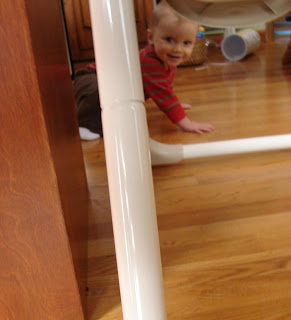
But I'm sure there are several fans waiting for an update on Caleb. Caleb has started to mimic us more often--clapping, stretching, playing peek-a-boo. We also played a rousing game of hide and seek around the kitchen island yesterday. He's also started shouting. I'm not sure who he learned that from. Fishlips are really cute on an 8-month-old. Caleb climbs the full set of stairs when he gets tired of playing with the basement toys.
On Valentine's Day, Luke and I were able to find a babysitter and go to the Valentine's Gala that several people from our church organized. I had a blast! We got to dress up, we laughed with friends, and we even left with a certificate for free babysitting. It was a wonderful way to spend Valentine's Day!
My parents visited on Monday, bringing dinner, homemade noodles (which we used for chicken noodle soup on Tuesday), doubly good chocolate cake, hugs, and grandparent hands itching to play with their grandson.
While we were sick I read several Dean Koontz books. If you haven't started reading his books, don't. If you've read one, you've read them all. I suppose they served their purpose of making me rest instead of doing stuff around the house. I'm sure there are better ways to rest.
I also rediscovered Library Thing. I'm really not sure what it's purpose is, except for people like me who read books and then can't remember if they've read them or not, or who can't remember titles of books they read.
After this random post, maybe I'll redeem myself with a picture from our game of hide and seek:
Sunday, January 11, 2009
So Brave, Young and Handsome
After thoroughly enjoying Peace Like a River by Leif Enger, I was excited to read his next book, So Brave, Young and Handsome. Unfortunately, I was disappointed. I only finished the book because it's an easy read and I was hoping for a spectacular finish. The ending wasn't so spectacular. Annoying, nonsensical characters and a wandering plot make for a tedious read. The author may have been trying to reinvent heroism, but I missed it between the slowest chase ever and the "I'm-supposed-to-be-a-deep-thought" one-liners at the end of almost every chapter. My recommendation: Don't waste your time hoping for a good ending to a bad book.
Thursday, January 8, 2009
Perspectives
If you're in the Cedar Rapids/Iowa City area, you should seriously consider taking Perspectives. I took the class in Ames several years ago, and it still gives my brain food for thought and my body motivation for action. The class isn't about becoming a missionary, although be forewarned. After taking this class, you may consider the possibility, even if you never have before. From my experience, Perspectives gives the big picture of God's purpose throughout the Bible, in the world, and in your life, as well as theoretical and practical applications. You can read more about the course's core ideas at the Perspectives website.
Perspectives also fits in perfectly with what Pastor Mark was speaking about last Sunday. Christianity isn't comfortable, or rather, it shouldn't be. Anyone who believes Jesus was born of a virgin, was born in a stable, healed all kinds of people, died on the cross, rose from the dead, and forgave the undeserving is going to have a difficult time being an armchair Christian (or as Pastor Mark was saying, a "moralistic therapeutic deist"). As Reuben Land from Peace Like a River would say, "Real miracles bother people." They bother you enough to change your life. If you're interested in staying your armchair, don't take Perspectives.
Perspectives also fits in perfectly with what Pastor Mark was speaking about last Sunday. Christianity isn't comfortable, or rather, it shouldn't be. Anyone who believes Jesus was born of a virgin, was born in a stable, healed all kinds of people, died on the cross, rose from the dead, and forgave the undeserving is going to have a difficult time being an armchair Christian (or as Pastor Mark was saying, a "moralistic therapeutic deist"). As Reuben Land from Peace Like a River would say, "Real miracles bother people." They bother you enough to change your life. If you're interested in staying your armchair, don't take Perspectives.
Monday, January 5, 2009
Peace Like a River--a story worth reading.
For the majority of my reading I'm torn between two poles. I can read something readable and enjoyable, but of no lasting consequence (i.e. pop fiction and Christianesque fiction) or I can read something serious, thought-provoking and painful (i.e. Pilgrim's Progress and Faulkner). I guess most reading is like most food: good or good-for-you. Peace Like a River by Leif Enger manages to bridge the gap between these two poles, creating some readable, seriously enjoyable, and thought-provoking fiction. I suppose if Peace Like a River were food, it'd be Citrus Salmon with Pineapple Orange Salsa.
The plot line is pretty far out there. Far enough that when I first came across the book and read the teaser paragraph, I dismissed it. After reading the book, the extraordinariness of the book became one of the things I loved about it. In fact the narrator's purpose is to serve as a witness to the miraculous. As he says several times in the book:
"Is there a single person on whom I can press belief?
No sir.
All I can do is say, Here's how it went. Here's what I saw.
I've been there and am going back.
Make of it what you will."
Ooo, I love that part. But you have to read the book to see how cool that part really is. I love the frank, straightforward approach of the narrator. No manipulation, no marketing. It's your choice whether you believe him or not. After all, he's speaking of miracles. And this is what he says about miracles:
"Let me say something about that word: miracle. For too long it's been used to characterize things or events that , though pleasant are entirely normal. Peeping chicks at Easter time, spring generally, a clear sunrise after an overcast week--a miracle, people say, as if they've been educated from greeting cards. I'm sorry, but nope. Such things are worth our notice every day of the week, but to call them miracles evaporates the strength of the word. Real miracles bother people, like strange sudden pains unknown in medical literature.... A miracle contradicts the will of the earth" (page 3).
Aside from the well-told story, this book was worth my time for several other reasons. The picture of a father frequently wrestling in prayer with someone alive and active was one treated carefully and not typecast as a fundamentalist freak show. Also refreshing was seeing a character committed to standing up for what's really right and wrong, not just legally right and wrong, and patiently training his son, Reuben, to do the same. This story lives and breaths faith, miracles, and an active and present God without having to pause for preaching. I did find the nine-year-old Shakespeare-Stevenson-Homer-quoting poet who reads gazillions of westerns and understands poetic meter (and despises free verse) slightly unbelievable, but in a book highlighting the miraculous, how can I argue with a character's plausibility? Characters in Peace Like a River turn an unbelievable, crazy kind of belief into real, compassionate, and faith-filled life. I highly recommend it--that kind of life and that kind of reading.
The plot line is pretty far out there. Far enough that when I first came across the book and read the teaser paragraph, I dismissed it. After reading the book, the extraordinariness of the book became one of the things I loved about it. In fact the narrator's purpose is to serve as a witness to the miraculous. As he says several times in the book:
"Is there a single person on whom I can press belief?
No sir.
All I can do is say, Here's how it went. Here's what I saw.
I've been there and am going back.
Make of it what you will."
Ooo, I love that part. But you have to read the book to see how cool that part really is. I love the frank, straightforward approach of the narrator. No manipulation, no marketing. It's your choice whether you believe him or not. After all, he's speaking of miracles. And this is what he says about miracles:
"Let me say something about that word: miracle. For too long it's been used to characterize things or events that , though pleasant are entirely normal. Peeping chicks at Easter time, spring generally, a clear sunrise after an overcast week--a miracle, people say, as if they've been educated from greeting cards. I'm sorry, but nope. Such things are worth our notice every day of the week, but to call them miracles evaporates the strength of the word. Real miracles bother people, like strange sudden pains unknown in medical literature.... A miracle contradicts the will of the earth" (page 3).
Aside from the well-told story, this book was worth my time for several other reasons. The picture of a father frequently wrestling in prayer with someone alive and active was one treated carefully and not typecast as a fundamentalist freak show. Also refreshing was seeing a character committed to standing up for what's really right and wrong, not just legally right and wrong, and patiently training his son, Reuben, to do the same. This story lives and breaths faith, miracles, and an active and present God without having to pause for preaching. I did find the nine-year-old Shakespeare-Stevenson-Homer-quoting poet who reads gazillions of westerns and understands poetic meter (and despises free verse) slightly unbelievable, but in a book highlighting the miraculous, how can I argue with a character's plausibility? Characters in Peace Like a River turn an unbelievable, crazy kind of belief into real, compassionate, and faith-filled life. I highly recommend it--that kind of life and that kind of reading.
Sunday, October 5, 2008
Coffee Break Inspiration
Anne of Green Gables is one reason I'm glad that I am a girl. While enjoying a break at my favorite coffee spot this weekend (without the coffee of course), I rediscovered some of Anne's wisdom.
After Anne goes to Marilla's church for the first time, Marilla scolds Anne for not listening to Mr. Bell pray while at church. This is how Anne responds: "But he wasn't talking to me. He was talking to God and he didn't seem to be very much interested in it, either. I think he thought God was too far off to make it worth while. I said a little prayer myself though. There was a long row of white birches hanging over the lake and the sunshine fell down through them, way, way down, deep into the water. Oh, Marilla, it was like a beautiful dream! It gave me a thrill and I just said, 'Thank you for it, God' two or three times."
After Anne goes to Marilla's church for the first time, Marilla scolds Anne for not listening to Mr. Bell pray while at church. This is how Anne responds: "But he wasn't talking to me. He was talking to God and he didn't seem to be very much interested in it, either. I think he thought God was too far off to make it worth while. I said a little prayer myself though. There was a long row of white birches hanging over the lake and the sunshine fell down through them, way, way down, deep into the water. Oh, Marilla, it was like a beautiful dream! It gave me a thrill and I just said, 'Thank you for it, God' two or three times."
Friday, September 26, 2008
Anna Karenina Update
I started reading Anna Karenina weeks ago, and I loved it. Loved the characters, their struggles, and the translation. Then I read the last sentence, and I was left speechless. I felt (and still feel) robbed and betrayed. How can one line of an eight hundred page book ruin the whole thing? Tolstoy delved into so many great questions and then gave me that answer? That's no answer! That's a trite band-aid to cover the fact that the questions he raised are still agonizingly, achingly unanswered.
I suppose it takes a good author to make me care enough about their story to be unsatisfied when their characters are unsatisfied instead of just dumping their unsatisfied characters back into the library drop box.
I suppose it takes a good author to make me care enough about their story to be unsatisfied when their characters are unsatisfied instead of just dumping their unsatisfied characters back into the library drop box.
Thursday, September 4, 2008
Current Reading
Is it a sign of arrogance or simply a mark of a good reader that I can see myself in every diverse character in Anna Karenina?
Wednesday, August 27, 2008
For the Time Being
"I thought, I too could...inquire, hollering at God the compassionate, the all-merciful, WHAT'S with the bird-headed dwarfs?" (53) This question seems to be a key argument in Annie Dillard's perception of the world and God's part in it.
I just finished reading For the Time Being by Annie Dillard. While not a thick book, it took me quite awhile to read simply becase I kept abandoning it for other reading or activity. It's a depressing book, so the beautiful summer weather has enticed me away from reading.
It consists of 7 chapters that are divided into sections about birth, sand, China, clouds, numbers, Israel, encounters, thinker, evil, and now. In each of these sections Dillard offers observations ranging from the smallest details of nature to mind-boggling numbers, all the while infusing various quotations from a multitude of famous and common people. Sometimes she highlights awesome of nature and humanity, but many times she highlights the awful (bird-headed dwarfs). Most of the time these observations seem arbitrary and unrelated, but Dillard connects most everything back to the big questions: Why am I here? Who is God? If God is good, why are there bird-headed dwarfs?
While I enjoy Dillard's ability to observe the world, wonder over the minute details in the world, and ask difficult questions, I draw very different conclusions than she does. Dillard sees the broken world and decides that God is either not powerful enough to fix it or doesn't care enough to fix it. In contrast, I believe that God's just waiting patiently. But as Dillard says, "I don't know beans about God" (169). She also quotes Augustine as saying, "We are talking about God. What wonder is it that you do not understand? If you do understand, then it is not God" (47). I agree with the idea that we can never fully understand God, but I also believe that we can absolutely know that God is who he says he is. While this doesn't answer all the difficult questions, it does help me know what questions to ask. Instead of beating my head against a brick wall of things I'll never understand, I'll try to understand what God has revealed about himself. For this reason, this book is an interesting read, but one I'll pass up in the future.
I just finished reading For the Time Being by Annie Dillard. While not a thick book, it took me quite awhile to read simply becase I kept abandoning it for other reading or activity. It's a depressing book, so the beautiful summer weather has enticed me away from reading.
It consists of 7 chapters that are divided into sections about birth, sand, China, clouds, numbers, Israel, encounters, thinker, evil, and now. In each of these sections Dillard offers observations ranging from the smallest details of nature to mind-boggling numbers, all the while infusing various quotations from a multitude of famous and common people. Sometimes she highlights awesome of nature and humanity, but many times she highlights the awful (bird-headed dwarfs). Most of the time these observations seem arbitrary and unrelated, but Dillard connects most everything back to the big questions: Why am I here? Who is God? If God is good, why are there bird-headed dwarfs?
While I enjoy Dillard's ability to observe the world, wonder over the minute details in the world, and ask difficult questions, I draw very different conclusions than she does. Dillard sees the broken world and decides that God is either not powerful enough to fix it or doesn't care enough to fix it. In contrast, I believe that God's just waiting patiently. But as Dillard says, "I don't know beans about God" (169). She also quotes Augustine as saying, "We are talking about God. What wonder is it that you do not understand? If you do understand, then it is not God" (47). I agree with the idea that we can never fully understand God, but I also believe that we can absolutely know that God is who he says he is. While this doesn't answer all the difficult questions, it does help me know what questions to ask. Instead of beating my head against a brick wall of things I'll never understand, I'll try to understand what God has revealed about himself. For this reason, this book is an interesting read, but one I'll pass up in the future.
Saturday, July 5, 2008
Where are the good guys?
I'm currently reading The Wheel of Time series by Robert Jordan, which is a fantasy saga that I wouldn't necessarily recommend to anyone, but has me thinking about good and evil and the definition of those terms.
Robert Jordan's writing is notable for his creation of an extensive make-believe world and gazillion characters, but I'd also describe his writing as slow, tedious, and lacking plot development. These books describe an epic struggle between good and evil (that evidently never ends...Jordan died before he finished the series), but the characters, aware of this epic struggle, are mired in petty arguments not only with their allies, but with their friends. It's clear Jordan knows where he wants his characters to end up, but he has a hard time making the journey by any other means than having the characters argue amongst themselves.
It's clear which characters are meant to be "the good guys;"they're mostly all on Rand's (the central character) side. But as I think about the "good" characters, I wonder what really distinguishes them from the bad guys. Both good and bad are manipulative to no end, self-centered, and stuck in never-ending petty arguments. Both groups use their "special powers" to achieve their own purposes and gain advantages for themselves. While the good guys all claim to live for "the Light"--whatever that is, it's left unexplained--many seem to think their own way of following the Light and fighting the Dark Lord is the sure way to success. Therefore, they end up in distrusting factions and acting on partial knowledge. (This train of thought has me considering the correlations to the modern church.)
Each good character also has his/her own code of conduct. The worst thing in Rand's perspective is to kill a woman (or let her be killed), and yet as much as he tries to avoid it, women die because of his actions. Nynaeve's battle is one for courage, and yet her flaming anger works well to hide her cowardice. Egwene says the following about evil in A Crown of Swords: "Do what you must, then pay the price for it, was what she had been taught. It was refusal to admit the debt, refusal to pay, that often turned necessity to evil" (Pg. 230). So according to Egwene, evil isn't in the action, it's in the intention and willingness to own up to it. And as the reader encounters a myriad of characters from various cultures and classes, he/she sees just as many different standards for right and wrong. The Aiel equate carrying a sword with evil, but bigamy is tradition. In Ebou Dar, fighting (and killing) in duels is standard practice, but to tell a lie is a great offense.
So what makes people (or characters) good? Tradition, intention, personal success? The question ties closely to my current study of Romans. The first half of Romans 2 states that there is one standard of righteousness that is based on truth (vs. 2). It also demonstrates that knowing the right thing to do isn't enough; doing the right thing is also required. Romans 2:13 says, "For it is not those who hear the law who are righteous in God's sight, but it is those who obey the law who will be declared righteous." By this standard, there aren't any good guys in The Wheel of Time series.
Robert Jordan's writing is notable for his creation of an extensive make-believe world and gazillion characters, but I'd also describe his writing as slow, tedious, and lacking plot development. These books describe an epic struggle between good and evil (that evidently never ends...Jordan died before he finished the series), but the characters, aware of this epic struggle, are mired in petty arguments not only with their allies, but with their friends. It's clear Jordan knows where he wants his characters to end up, but he has a hard time making the journey by any other means than having the characters argue amongst themselves.
It's clear which characters are meant to be "the good guys;"they're mostly all on Rand's (the central character) side. But as I think about the "good" characters, I wonder what really distinguishes them from the bad guys. Both good and bad are manipulative to no end, self-centered, and stuck in never-ending petty arguments. Both groups use their "special powers" to achieve their own purposes and gain advantages for themselves. While the good guys all claim to live for "the Light"--whatever that is, it's left unexplained--many seem to think their own way of following the Light and fighting the Dark Lord is the sure way to success. Therefore, they end up in distrusting factions and acting on partial knowledge. (This train of thought has me considering the correlations to the modern church.)
Each good character also has his/her own code of conduct. The worst thing in Rand's perspective is to kill a woman (or let her be killed), and yet as much as he tries to avoid it, women die because of his actions. Nynaeve's battle is one for courage, and yet her flaming anger works well to hide her cowardice. Egwene says the following about evil in A Crown of Swords: "Do what you must, then pay the price for it, was what she had been taught. It was refusal to admit the debt, refusal to pay, that often turned necessity to evil" (Pg. 230). So according to Egwene, evil isn't in the action, it's in the intention and willingness to own up to it. And as the reader encounters a myriad of characters from various cultures and classes, he/she sees just as many different standards for right and wrong. The Aiel equate carrying a sword with evil, but bigamy is tradition. In Ebou Dar, fighting (and killing) in duels is standard practice, but to tell a lie is a great offense.
So what makes people (or characters) good? Tradition, intention, personal success? The question ties closely to my current study of Romans. The first half of Romans 2 states that there is one standard of righteousness that is based on truth (vs. 2). It also demonstrates that knowing the right thing to do isn't enough; doing the right thing is also required. Romans 2:13 says, "For it is not those who hear the law who are righteous in God's sight, but it is those who obey the law who will be declared righteous." By this standard, there aren't any good guys in The Wheel of Time series.
Sunday, June 22, 2008
Romans
Our church is just beginning a study of the book of Romans. I'm excited about it--partly because I usually like studying books more than I like studying random topics, and partly because there's a lot of truth stated so clearly in Romans that has changed my life. I'm a little behind in my personal study of the book--it seems like someone starts to cry whenever I sit down to start, and it's not always Caleb. In the Sunday messages and the blog, the NET version of the Bible is being used. I'm not familiar with this translation at all, but it lent me a new perspective this past week.
At the end of Romans 1:17, Paul quotes the Old Testament saying, "The righteous will live by faith." (NIV) Only in the NET it reads, "The righteous by faith will live." As a former English teacher, I could have lots of fun dissecting the subtle differences of these two sentences that contain the same words, but I think it'd just reveal my over-analytical, somewhat-crazy brain. It'd also go against the fact that these two translations do have the same meaning. What I've been pondering this week is my personal understanding of this verse. In the past I've misunderstood this verse as saying, "If you are righteous, you will live by faith," which makes the verse into a self-centered, you-must-work-harder command that I must follow instead of a simple statement of fact. It turns it into a personal quest for more faith and more righteousness--as if that's even possible. As I've been thinking about this verse this week, I've seen the promise that it holds. It really is a foreshadowing of the gospel that Paul so carefully explains in detail later in Romans. Through the faith that God gives (Eph. 2:9), I have been declared righteous (Romans 3:22 and others), and therefore I will truly live! It's a summary of the incredibly good news of Christ, and a promise of life--not only eternal life, but also a new life (Romans 6:4, 10-11). Yet another promise to hold closely.
Disclaimer: I'm hesitant about posting this entry, especially now that more than one other person knows I have a blog. This is the personal process document of a sleep-deprived lady who hasn't found a lot to time to study the Bible lately. I'm not out to explain theology or provide commentary on the book of Romans--there are better sources for that.
At the end of Romans 1:17, Paul quotes the Old Testament saying, "The righteous will live by faith." (NIV) Only in the NET it reads, "The righteous by faith will live." As a former English teacher, I could have lots of fun dissecting the subtle differences of these two sentences that contain the same words, but I think it'd just reveal my over-analytical, somewhat-crazy brain. It'd also go against the fact that these two translations do have the same meaning. What I've been pondering this week is my personal understanding of this verse. In the past I've misunderstood this verse as saying, "If you are righteous, you will live by faith," which makes the verse into a self-centered, you-must-work-harder command that I must follow instead of a simple statement of fact. It turns it into a personal quest for more faith and more righteousness--as if that's even possible. As I've been thinking about this verse this week, I've seen the promise that it holds. It really is a foreshadowing of the gospel that Paul so carefully explains in detail later in Romans. Through the faith that God gives (Eph. 2:9), I have been declared righteous (Romans 3:22 and others), and therefore I will truly live! It's a summary of the incredibly good news of Christ, and a promise of life--not only eternal life, but also a new life (Romans 6:4, 10-11). Yet another promise to hold closely.
Disclaimer: I'm hesitant about posting this entry, especially now that more than one other person knows I have a blog. This is the personal process document of a sleep-deprived lady who hasn't found a lot to time to study the Bible lately. I'm not out to explain theology or provide commentary on the book of Romans--there are better sources for that.
Subscribe to:
Posts (Atom)